
The Goods and Services Tax (GST) Council plays a crucial role in shaping India’s indirect tax system. Formed under Article 279A of the Indian Constitution, it comprises the Union Finance Minister and representatives from all states and Union Territories. The Council’s primary objective is to ensure efficient GST implementation by deciding on tax rates, exemptions, and administrative procedures.
Overview of the Goods and Services Tax Council in India
Formation
- Background of GST in India: The idea of a nationwide GST in India was first proposed by the Kelkar Task Force on Indirect taxes in 2000.
- Need for Coordination: The smooth and efficient administration of goods and services tax (GST) requires co-operation and coordination between the Centre and the States.
- Establishment of the GST Council: To facilitate this consultation process, the 101st Constitutional Amendment Act provided for the establishment of a Goods and Services Tax Council or the GST Council.
- Constitutional Mandate: The amendment inserted a new Article 279A (1) in the Constitution, which empowered the President to constitute a GST Council by an order within 60 days of the commencement of Article 279A.
- Formation of the Council: Accordingly, the President issued the order in 2016 and constituted the Council.
- Secretariat and Leadership: The Secretariat of the Council is located in New Delhi, and the Union Revenue Secretary acts as the ex-officio Secretary to the Council.
Goods and Services Tax
- The Goods and Services Tax regime came into force after the Constitutional (122nd Amendment) Bill was passed by both Houses of Parliament in 2016.
- It was introduced in India on 1st July 2017, through the 101st Constitution Amendment Act, 2016, with the slogan of ‘One Nation One Tax’.
- It is a value-added comprehensive indirect tax system levied on the supply of goods and services in India.
To establish the highest standards of cooperative federalism in the functioning of the Council, which is the first Constitutional federal body vested with powers to take all major decisions related to GST.
To impartially, uniformly, and efficiently administer the GST Act, ensuring maximum tax collection and establishing a consistent indirect-tax structure throughout the country.
Membership
The Council consists of the following members:
- The Union Finance Minister as the Chairperson.
- The Union Minister of State in-charge of Revenue or Finance.
- State Representatives: The Minister in-charge of Finance or Taxation or any other Minister nominated by each state government.
- Vice-Chairperson Selection: The members of the GST Council shall choose one amongst themselves as Vice-Chairperson of the Council, for such a period as they may decide.
- Permanent Invitee: The Union Cabinet also decided to include the Chairperson of the Central Board of Excise and Customs (CBEC) as a permanent invitee (non-voting) to all proceedings of the Council.
Working of the Council
- Quorum – Article 279A(7): One-half of the total number of members of the Council is the quorum for conducting a meeting.
- Decision Making – Article 279A(9): Every decision of the Council is to be taken by a majority of not less than 3/4th of the weighted votes of the members present and voting at the meeting.
The decision is taken in accordance with the following principles:
- The vote of the central government shall have a weightage 1/3rd of the total votes cast in that meeting.
- The votes of all the state governments combined shall have a weightage of 2/3rd of the total votes cast in that meeting.
Validity of Proceedings – Article 279A(10)
Any act or proceedings of the Council will not become invalid on the following grounds:
- Any vacancy or defect in the Constitution of the Council; or
- Any defect in the appointment of a person as a member of the Council; or
- Any procedural irregularity of the Council not affecting the merits of the case.
Responsibilities
Article 279A(4): The Council is required to make recommendations to the center and the states on the following matters:
- Taxes, Cesses, and Surcharges: The taxes, cesses, and surcharges levied by the center, the states, and the local bodies that would be subsumed in GST.
- Goods and Services Subjected to GST: The goods and services that may be subjected to GST or exempted from GST.
- Model GST Laws and Principles of Levy: Model GST Laws, principles of levy, apportionment of GST levied on supplies in the course of inter-state trade or commerce under Article 269A, and the principles that govern the place of supply.
- Threshold Limit for Exemption: The threshold limit of turnover below which goods and services may be exempted from GST.
- GST Rates: The rates include floor rates with bands of GST.
- Special Rates During Natural Calamities: Any special rate or rates for a specified period to raise additional resources during any natural calamity or disaster.
- Special Provisions for Certain States: Special provision with respect to the states of Arunachal Pradesh, Assam, Jammu and Kashmir, Manipur, Meghalaya, Mizoram, Nagaland, Sikkim, Tripura, Himachal Pradesh and Uttarakhand.
- Other Matters Relating to GST: Any other matter relating to GST, as the Council may decide.
Additional Role of the GST Council are as follows
- Article 279A(5): The Council shall recommend the date on which the GST may be levied on petroleum crude, high speed diesel, motor spirit (petrol), natural gas and aviation turbine fuel.
- Article 279A(8): The Goods and Services Tax Council shall determine the procedure for performing its functions.
- Article 279A(11): When there is a dispute with respect to its recommendations or their implementation, the Council shall establish a mechanism to adjudicate upon the dispute between the centre and one or more states; between the centre and any state(s) on one side and other state(s) on the other; or between two or more states.
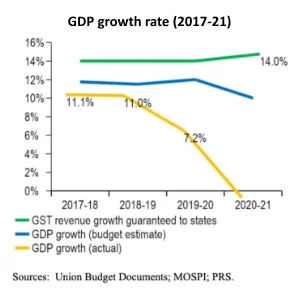
- Compensation to the States: The GST Council has to recommend compensation to the states for loss of revenue arising on account of the introduction of GST for a period of five years between 2017 and 2022 funded by GST. Based on this recommendation, Parliament enacted the Goods and Services Tax (Compensation to States) Act 2017.
The Issues in GST Council
Virtual Veto: The Center’s 1/3rd share of the voting rights and the requirement for 3/4th of the votes to make changes, effectively bestow the Center with a veto power over decisions in the GST Council.
Complex Decision-Making Process: The GST Council generally operates on a consensus-based decision-making model, which can result in delays in making critical decisions.
Inequity in Representation: Some states argue that the division of votes does not always reflect their economic and population size. Example: Tamil Nadu has consistently highlighted this concern.
Limited Autonomy for States: States have expressed concerns about limited autonomy in making decisions regarding their own tax policies. Example: Kerala couldn’t increase the tax rate to gather much-needed funds during floods.
Need for Clarity and Consistency: Demand for predictable tax laws. Example: FICCI has advocated for a long-term stable taxation regime.
Input from Other Stakeholders: Critics argue that involvement of industry experts and taxpayers is limited.
Suggestive Measures to improve the functioning
- Increasing Consensus-Building Mechanisms: Adopt structured practices such as forming smaller working groups for contentious issues.
- Enhancing Transparency and Stakeholder Engagement: Publish detailed minutes and conduct consultations with businesses, trade unions, and consumer groups.
- Capacity Building: Conduct regular training programs for state tax officials to ensure uniformity.
- Research and Development: Set up a research wing within the GST Council to study international best practices.
- Flexible Rate Structures: Create provisions for a flexible rate structure that can be adapted to changing conditions without full council consensus.
The GST Council has transformed the indirect tax landscape in India, fostering cooperation between the Centre and states. By addressing challenges such as decision-making delays and limited state autonomy, the Council can further enhance its effectiveness. Implementing suggested measures will help create a more efficient and inclusive tax environment, benefiting businesses and citizens alike.
Constitutional Provisions Pertaining to the GST Council
| Article | Subject-Matter |
|---|---|
| Article 279A | Goods and Service tax Council |
| Article 279A(1) | The GST Council has to be constituted by the President within 60 days of the commencement of Article 279A. |
| Article 279A(2) | Members of the Goods and Services Tax Council |
| Article 279A(3) | Members shall choose a Vice-Chairperson from amongst themselves. |
| Article 279A(4) | The Council shall make recommendations to the Union and the States. |
| Article 279A(5) | Recommendation of the date for GST levy on petroleum products. |
| Article 279A(6) | Guided by the need for a harmonised structure and a national market. |
| Article 279A(7) | Quorum at its meetings. |
| Article 279A(8) | The Council shall determine the procedure for its functions. |
| Article 279A(9) | Decision-making through weighted majority. |
| Article 279A(10) | No act of Council shall be invalid due to vacancy, defect in appointment, or procedural irregularity. |
| Article 279A(11) | Establishment of a mechanism to adjudicate any dispute. |