India’s rich linguistic diversity, with over 120 languages, is essential to its cultural heritage. Established in 1957, this role aims to investigate and report on the safeguards for linguistic minorities, promoting respect and awareness within society.
Constitution of Special Officer for Linguistic Minorities
India’s Linguistic Richness
India’s linguistic richness, with over 120 languages spoken, forms the bedrock of its cultural heritage.
- Importance of Preservation: Preserving this diversity is paramount to safeguarding India’s unique identity and ensuring the equal participation of all linguistic communities.
- Promoting Multilingualism: By promoting multilingualism and fostering respect for minority languages, we can nurture a more inclusive and harmonious society where every voice is heard and valued.
Legislative & Historical Framework
- Legislative Framework: Based on the recommendations of the State Re-organisation Commission, the 7th Constitutional (Amendment) Act, 1956 was enacted, whereby Article 350 B was added to the Constitution.
- Historical Context: Originally, the Indian Constitution didn’t entail any provisions regarding Special Officers for Linguistic Minorities.
- SRC 1956: The States Reorganisation Commission recommended the creation of a mechanism to address the grievances of Linguistic Minorities.
Constitutional Provisions (Article 350 B)
Article 350 B in Part XVII contains the following provisions:
- Appointment: There shall be a Special Officer for linguistic minorities to be appointed by the President.
- Duties: It shall be the duty of the Special Officer to investigate all matters relating to the safeguards provided for linguistic minorities and report to the President at such intervals as directed.
- Reporting: The President shall cause all such reports to be laid before each House of Parliament and sent to the Governments of the States concerned.
About the Office
- Official Title: Known as the Commissioner for Linguistic Minorities.
- Headquarters: Situated in Allahabad (Prayagraj), Uttar Pradesh.
- Regional Offices: Supported by three offices in Belgaum (Karnataka), Chennai (Tamil Nadu), and Kolkata (West Bengal), each headed by an Assistant Commissioner.
- Tenure & Conditions: The Constitution does not specify the qualifications, tenure, salaries, allowances, service conditions, and procedure for removal.
- Parent Ministry: This office falls under the Ministry of Minority Affairs.
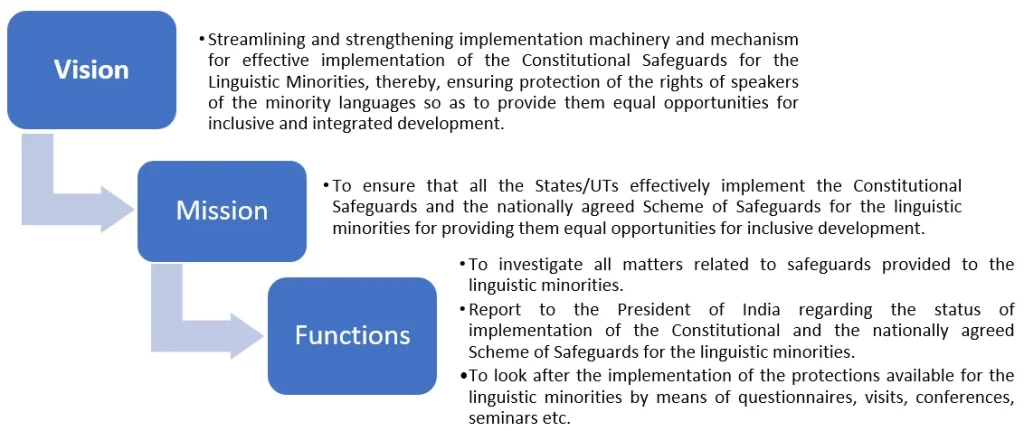
Vision, Mission and Key Objectives
The primary focus is to provide linguistic minorities with equal opportunities and platforms for development, contributing to overall national integration.
Issues Related to Linguistic Minorities
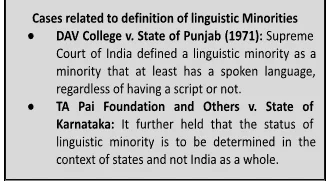
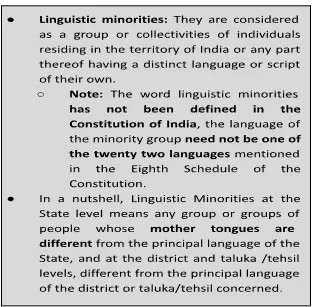
- Definition: Neither the Constitution nor any legislation defines "linguistic minorities." According to the Report of the National Commission for Religious and Linguistic Minorities (NCRLM), the status is determined by numerical inferiority, non-dominant status in a state, and possessing a distinct identity.
- Socio-economic Backwardness: As per the NCRLM report, exclusive adherence to a minority language is a leading factor that contributes to socio-economic backwardness.
- Vulnerability: The vulnerability of a language to extinction and lack of institutional support. Per UNESCO Atlas, 197 languages are endangered or nearing extinction in India.
- Dominance of Majority: Individuals and communities often learn the majority language to survive, which can marginalize indigenous mother tongues. Affirmative action is effectively utilized only if instruction is in their own language.
Safeguards to Linguistic Minorities
Safeguards derive authority from two primary sources:
1. The Constitution of India
| Article | Description of Safeguard |
|---|---|
| Article 29 | Right of any section of citizens residing in India having a distinct language, script, or culture to conserve the same. |
| Article 30 | Right of all minorities, based on religion or language, to establish and administer educational institutions. |
| Article 347 | President may direct official recognition of a language spoken by a substantial proportion of a State's population. |
| Article 350 | Every person is entitled to submit a representation for redressal in any of the languages used in the Union or State. |
| Article 350 A | Endeavour of every State and local authority to provide instruction in mother tongue at the primary stage. |
| Article 350 B | Appointment of a Special Officer to investigate matters relating to constitutional safeguards. |
2. Consensual Safeguards (2023)
- 15% Rule: Translation/publication of rules/notices in minority languages where speakers are 15% or more.
- 60% Rule: Declaration of minority language as a second official language in districts where speakers constitute 60% or more.
- Education: Provision for instruction through mother tongue at the primary and secondary stages.
- State Responsibility: The basic responsibility lies with the State Governments and UT Administrations, which must appoint nodal officers.
Conclusion
The Special Officer for Linguistic Minorities plays a vital role in safeguarding the rights of linguistic communities in India. By addressing grievances, promoting awareness, and ensuring the implementation of constitutional safeguards, this position fosters a more inclusive society. It is essential for government bodies to actively support these efforts to preserve linguistic diversity and promote national integration.