Judicial review is a vital power granted to the Supreme Court and High Courts in India, allowing them to assess the constitutionality of laws and executive actions. This authority ensures that no law or action can violate the fundamental rights enshrined in the Constitution. Recognized as a fundamental aspect of the Constitution’s basic structure, judicial review upholds the rule of law and protects citizens from arbitrary governance. Thus, it serves as a crucial check on legislative and executive powers in the country.
The Doctrine of Judicial Review in India
- Origin: The doctrine of judicial review originated and developed in the USA. It was propounded for the first time in the famous case of Marbury versus Madison (1803) by John Marshall, the then Chief Justice of the American Supreme Court.
- Constitutional Authority: In India, the Constitution itself confers the power of judicial review on the judiciary i.e. for both the Supreme Court as well as High Courts.
- Meaning of Judicial Review: It is the power of the judiciary to examine the constitutionality of legislative enactments and executive orders of both the Central and State governments.
- Declaration of Invalidity: If they are found to be violative of the Constitution (ultra vires), then they are declared as illegal, unconstitutional, and invalid by the judiciary. Consequently, they cannot be enforced by the Government.
- Basic Feature of the Constitution: The Supreme Court has declared the power of judicial review as a basic feature of the Constitution or an element of the basic structure of the Constitution.
- Inviolability of Judicial Review: Consequently, the power of judicial review cannot be curtailed or excluded even by a constitutional amendment.
Classification of Judicial Review
According to Justice Syed Shah Mohamed Quadri they can be classified into the following three categories:
- Judicial review of constitutional amendments.
- Judicial review of legislation of the Parliament and State Legislatures and subordinate legislations.
- Judicial review of administrative action of the Union and State and authorities under the state.
Landmark Cases of Judicial Review:
- Golaknath case (1967)
- Bank Nationalisation case (1970)
- Privy Purses Abolition case (1971)
- Kesavananda Bharati case (1973)
- Minerva Mills case (1980)
- Ruling on 99th Constitutional Amendment (2015): The Supreme Court declared both the 99th Constitutional Amendment, 2014 and the National Judicial Appointments Commission (NJAC) Act, 2014 as unconstitutional and null and void.
Importance of Judicial Review
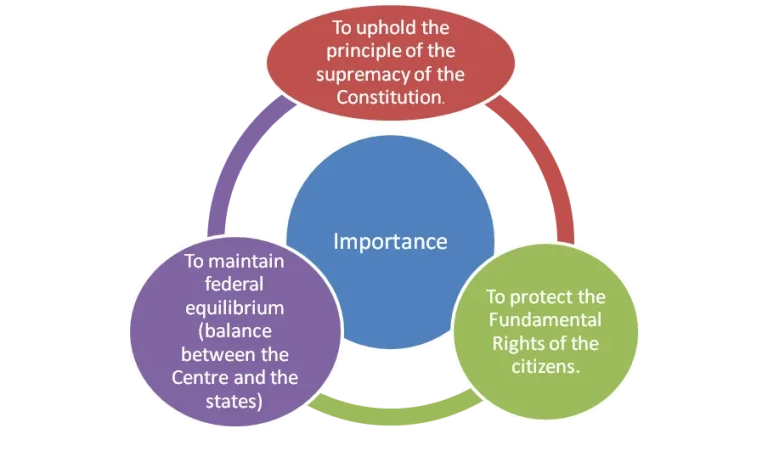
Judicial review is needed for the following reasons:
- To prevent the tyranny of executives and maintain the federal balance.
- For checking the misuse of power by the legislature and executive.
- For maintaining supremacy of the Constitution.
- Securing the independence of the judiciary.
- Protecting the rights of the people.
Constitutional Provisions for Judicial Review
Though the phrase ‘Judicial Review’ has nowhere been used in the Constitution, there are various provisions from several Articles which explicitly confer the power of judicial review on the Supreme Court and the High Courts. These provisions are explained below:
- Article 13: All laws are inconsistent with or in derogation of the Fundamental Rights shall be null and void.
- Article 32: Guarantees the right to move to the Supreme Court for the enforcement of Fundamental Rights. It empowers the Supreme Court to issue directions or orders or writs.
- Article 131: Provides for the original jurisdiction of the Supreme Court in centre-state and inter-state disputes.
- Article 132: Provides for the appellate jurisdiction of the Supreme Court in constitutional cases.
- Article 133: Provides for the appellate jurisdiction of the Supreme Court in civil cases.
- Article 134-A: Deals with the certificate for appeal to the Supreme Court from the High Courts.
- Article 135: Empowers the Supreme Court to exercise the jurisdiction and powers of the Federal Court under any pre-constitutional law.
- Article 136: The Supreme Court grants special leave to appeal from any court or tribunal (except military).
- Article 143: The President is authorised to seek the opinion of the Supreme Court on any question of law or fact.
- Article 226: The High Court issue directions or writs for the enforcement of the Fundamental Rights.
- Article 227: The High Courts have the power of superintendence over all courts and tribunals within their jurisdiction (except military).
- Article 245: The territorial extent of laws made by Parliament and by the Legislatures of States.
- Article 246: The subject matter of laws made by Parliament and State Legislatures (Union, State, and Concurrent Lists).
- Articles 251 and 254: For conflict cases between central law and state law, the central law prevails over the state law.
- Article 372: Deals with the continuance in force of the pre-Constitution laws.
Scope of Judicial Review
If any law or an executive order is passed, its constitutional validity can be challenged in the Supreme Court or High Court for the following reasons:
- Infringement of Fundamental Rights.
- If outside the competence of the authority which has framed it.
- If it is repugnant to the constitutional provisions.
Scope in India vs. USA
USA: "Due Process of Law"
- The American Constitution provides for ‘due process of law’.
- This grants broader protections for citizens’ rights.
- Allows challenges on both substantive and procedural grounds (i.e., the court can question the fairness and reasonableness of the law itself).
India: "Procedure Established by Law"
- The Indian Constitution (Article 21) contains ‘procedure established by law’.
- This makes the scope of judicial review in India narrower.
- Judicial review primarily focuses on substantive issues (i.e., if the law was made correctly) without delving into the reasonableness or policy implications.
Evolution: The Maneka Gandhi Case
After the Maneka Gandhi v. Union of India (1978) case, the Supreme Court interpreted that the phrase “due process of law” is implicit in Article 21.
- This decision expanded the scope of the right to personal liberty.
- It ensures that the government cannot deprive individuals of their life, liberty, or property without adhering to a procedure that is fair, just, and reasonable.
- This means that in India, due process of law is now a protection against arbitrary executive action and also against arbitrary legislative action.
Judicial Review of the Ninth Schedule
- Protection of Ninth Schedule Acts: As per Article 31B, acts and regulations placed in the Ninth Schedule are protected from being challenged on the ground of contravention of any of the Fundamental Rights.
- Insertion of Article 31B: This article was inserted by the 1st Constitutional Amendment Act of 1951 to protect land reforms and other laws from judicial review.
- Golaknath v. State of Punjab (1967): The Supreme Court held that Parliament did not have the power to amend Fundamental Rights (this was later overturned by the 24th Amendment).
- Kesavananda Bharati v. State of Kerala (1973): The Supreme Court held that there were limitations on the amending power and that the basic structure of the Constitution could not be altered. This date (April 24, 1973) becomes crucial.
- I.R. Coelho case (2007): This landmark ruling clarified the position on the Ninth Schedule.
- The Supreme Court ruled that judicial review is a ‘basic feature’ of the Constitution and can’t be taken away by simply putting a law under the Ninth Schedule.
- It held that any law placed in the Ninth Schedule after April 24, 1973, is subject to judicial scrutiny.
- Such laws can be challenged if they violate Fundamental Rights guaranteed under Articles 14, 19, 21 or the 'basic structure' of the Constitution.
- However, actions taken and transactions finalised as a result of the impugned Acts (before the judgment) shall not be open to challenge.
Limitation of Judicial Review
- It limits the functioning of the government and is permissible only to find if the procedure in reaching the decision has been correctly followed, not the decision itself (in most cases).
- The opinions of the judges once taken for any case become the standard for ruling other cases (precedent).
- It violates the limit of power set to be exercised by the Constitution when it overrides any existing law.
- The judgments can be influenced by personal or selfish motives of the judges.
- It may violate the principle of Separation of Power by allowing the judiciary to interfere in legislative or executive matters.
Conclusion
Judicial review plays a critical role in maintaining the balance of power within Indian democracy. It not only protects fundamental rights but also upholds the supremacy of the Constitution.
While there are limitations to this power, its significance in preventing misuse of authority cannot be overstated.
Ultimately, judicial review ensures that justice prevails and that the government remains accountable to the people it serves.