
Introduction to Judicial Activism
Judicial activism refers to the proactive role of the judiciary in protecting citizens’ rights and ensuring justice. It emerged in the United States in 1947 and was later adopted in India by influential judges in the 1970s. This concept empowers judges to interpret laws flexibly, often stepping in when the legislative or executive branches fail to uphold their duties. Judicial activism aims to address societal issues and safeguard constitutional values.
Meaning of Judicial Activism
- Origin: First coined by Arthur Schlesinger Jr. in 1947 in the USA. In India, it was introduced in the mid-1970s by Justices V.R. Krishna Iyer, P.N. Bhagwati, etc.
- Definition: The active role of the judiciary in upholding the rights of citizens and preserving the constitutional and legal system.
- Proactive Role: Denotes the judiciary's proactive role for the protection of rights and promotion of justice in society.
- Judicial Obligation: Implies the judiciary's role to force the legislature and executive to fulfill their constitutional obligations.
- Judicial Dynamism: It is also known as "judicial dynamism".
- Comparison: Works oppositely to "judicial restraint," which implies self-control exercised by the judiciary.
Significance of Judicial Activism
Exercise of Judicial Power
Motivates judges to depart from strict adherence to judicial precedent in favour of progressive and new social policies.
Protection of Individual Rights
Practice to protect or expand individual rights through decisions that move away from established precedent.
Active Interpretation
Denotes an active interpretation of earlier legislation made by a judge to enhance the utility of that law for social betterment.
Philosophy of Decision-Making
A philosophy where judges are allowed to use their personal views about public policy for guidance to others.
Evolution of Legal Principles
Helps to evolve new principles, concepts, maxims, formulae and relief to do justice.
Relation to PIL
Judicial activism is closely related to the concept of Public Interest Litigation (PIL).
Need for Judicial Activism
- The failure of the executive and legislatures to deliver the desired results.
- Rampant corruption and violation of basic human rights through government agencies.
- Occurs because the entire system has been plagued by ineffectiveness and inactiveness.
- Due to the misuse and abuse of some provisions, the principles of democracy were continuously degrading.
- In such a scenario, the judiciary was forced to play an active role to correct various wrongs and prevent the compromise of democracy.
Manifestation & Key Cases
Manifestation of Judicial Activism
- Through Judicial Review
- Through Public Interest Litigation (PIL)
- Through Constitutional Interpretation
- Through access to international statutes for ensuring constitutional rights
Cases Associated with Activism
- A.K. Gopalan v. State of Madras (1950)
- I. C. Golaknath & Ors vs State Of Punjab (1967)
- Kesavananda Bharati case (1973)
- Hussainara Khatoon (I) v. State of Bihar (1979)
- Sheela Barse v. State of Maharashtra (1983)
Judicial Review vs. Judicial Activism

| Basis | Judicial Review | Judicial Activism |
|---|---|---|
| Definition | The process where the judiciary reviews the validity of laws passed by the legislature. | Interprets the Constitution to deal with contemporary issues; Judiciary uses its authority. |
| Goals | Reviews laws which are against Fundamental Rights. | Has the power to overrule any acts or decisions. |
| Intent | Reviews the validity of the laws under Article 13. | Use of Judicial authority to enforce what is essential for society. |
| Power | Judge uses power to protect and enforce Fundamental Rights. | Judges use power especially when constitutional bodies are not acting properly. |
| Example | Striking down Section 66A of the IT Act. | Mechanisms with no constitutional backing i.e. suo-motto cases, PIL, new doctrines. |
Justification of Judicial Activism
Dr. B.L. Wadehra's View
Activism happens due to:
- Collapse of responsible government.
- Citizens expect protection from the judiciary.
- Judges encourage PIL and relax 'Locus Standi'.
Subhash Kashyap's View
Overstep happens when:
- Legislature fails its responsibilities.
- A 'hung' legislature leads to inaction.
- Political unwillingness to take hard decisions.
- Failure to protect basic rights of citizens.
Apprehension of Judicial Activism
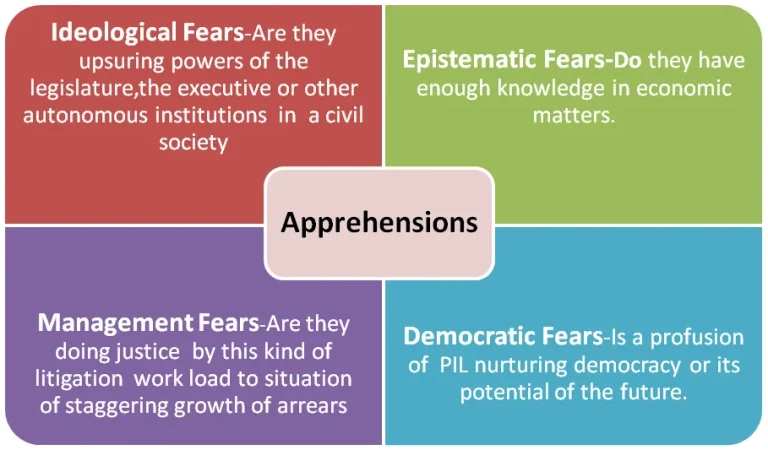
Judicial Activism vs. Judicial Restraint

| Judicial Activism | Judicial Restraint |
|---|---|
| Judges go beyond strict judicial function and enter political policymaking areas. | Judges hesitate to strike down laws unless they seem unconstitutional. |
| Loosely interprets and applies the Constitution based on ongoing changes and values. | Follows a strict interpretation of the Constitution. |
| Decides cases on the "spirit" of the Constitution and is willing to overturn legislation. | Decides cases on the "letter" of the Constitution, giving legislation the benefit of doubt. |
Judicial Overreach
Judicial overreach refers to instances where the judiciary, beyond its constitutional mandate, becomes excessively active in policymaking or infringes upon the domain of the executive and legislative branches.
There is a thin line dividing judicial activism and judicial overreach. When Judicial Activism goes overboard and becomes Judicial Adventurism, it is referred to as Judicial Overreach.
Impact of Judicial Overreach
- Threatens the doctrine of separation of powers, undermining the spirit of the constitution.
- Creates a lack of harmony between the legislature and judiciary.
- Expert knowledge (e.g., environmental, ethical) is required in certain cases, which the judiciary might not possess.
- Judgements without expertise can be harmful to the country.
Examples of Judicial Overreach
- Censorship of the Film "Jolly LLB II" by a court.
- The Supreme Court banning the sale of liquor within 500m of any national or state highway on a PIL about road safety.
Supreme Court’s Call for Judicial Restraint
The Supreme Court has itself reminded other courts, in 2007, to practise Judicial restraint.
“Judges must know their limits and must try not to run the government. They must have modesty and humility, and not behave like emperors.”
Further, it said, “In the name of judicial activism, judges cannot cross their limits and try to take over states which belong to another organ of the state”.
Conclusion
- Judicial activism plays a vital role in promoting justice and protecting individual rights in India.
- While it empowers the judiciary to intervene when other branches of government fail, it also raises concerns about judicial overreach.
- Striking a balance between activism and restraint is essential to maintain the integrity of the judicial system and uphold the principles of democracy.